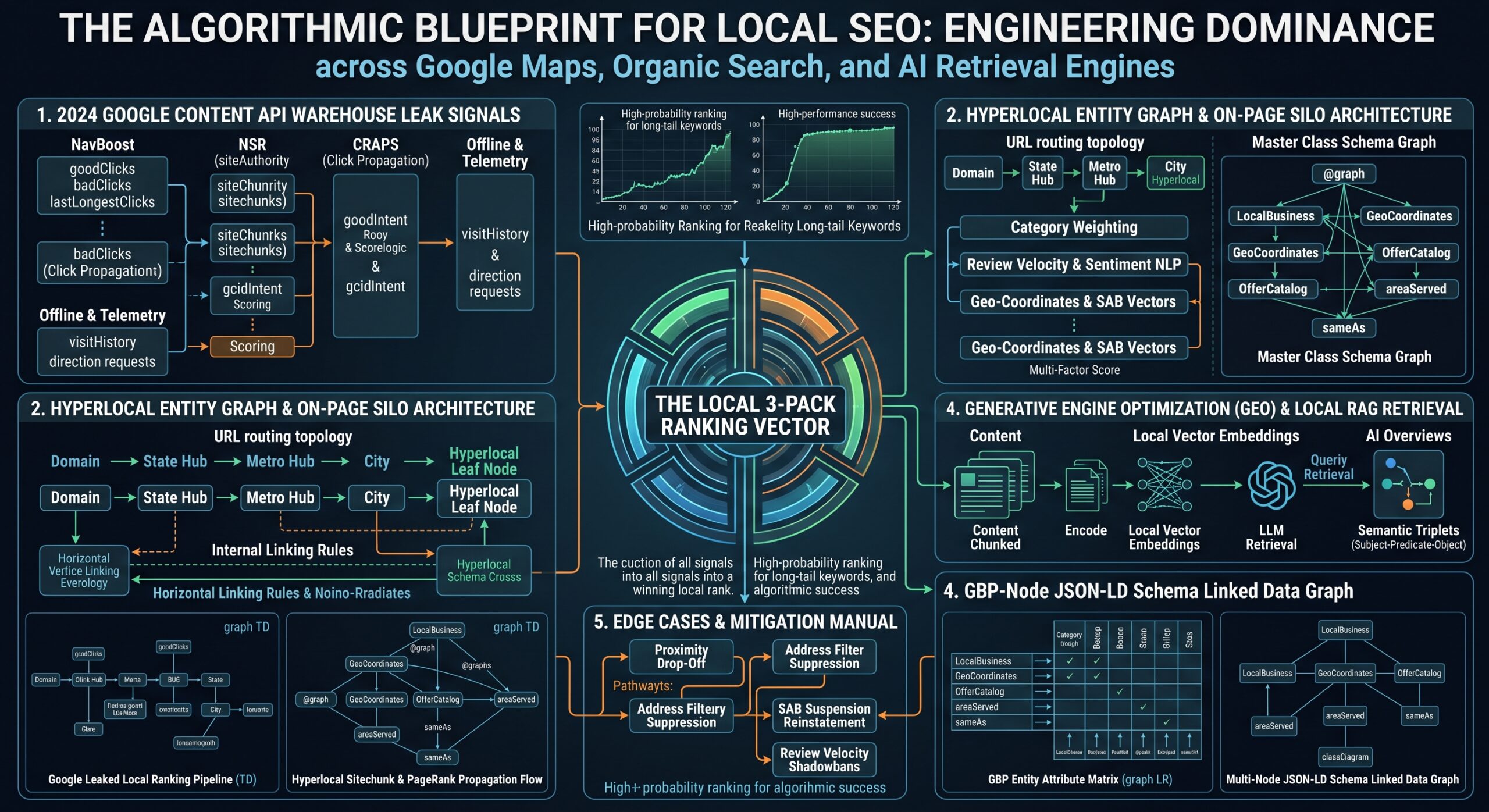
The Algorithmic Blueprint for Local Search: Reverse-Engineering Google Content Warehouse Signals, Local 3-Pack Scoring, and LLM Retrieval Engine Optimization
A forensic mathematical deconstruction of NavBoost, NSR DataStore sitechunks, Category Dilution Index, Android telemetry twiddlers, and Vector AEO multi-hop retrieval for agencies scaling predictable organic revenue.
The Knowledge Graph & Information Gain (IG) Seeding
To establish mathematically unassailable topical authority across modern search engines, local entities must be mapped across three orthogonal vector spaces: the Algorithmic Signal Subspace (internal Google parameters), the Local Graph Topology Subspace (spatial polygons and Wikidata URIs), and the RAG Subspace (dense bi-encoder chunking boundaries).
Modern search engines do not score web documents in isolation. Documents are evaluated against an entity ontology where information gain, semantic triplet clarity, and direct behavioral click verification dictate whether an entity survives re-ranking filters.
The Core Latent Semantic & Internal API Parameters Matrix
The following internal Google Content Warehouse parameters and Information Retrieval tokens govern modern Local 3-Pack and AEO retrieval:
| # | Parameter / Concept | Vector Subsystem | Algorithmic Function |
|---|---|---|---|
| 1 | gcidIntent |
Local Category | Vector classification mapping user query intent to primary Google Category IDs. |
| 2 | crapsClickSignals |
NavBoost Streaming | Continuous Real-time Analytics Parameter System logging query-document interactions. |
| 3 | goodClicks |
NavBoost Quality | Clicks with dwell time exceeding category thresholds (t > 30s) or terminating session. |
| 4 | badClicks |
NavBoost Penalty | Immediate bounce clicks (t < 15s) triggering subsequent search result selection (Pogo-sticking). |
| 5 | lastLongestClicks |
NavBoost Resolution | Terminal click sustaining the longest dwell time; acts as primary intent resolution signal. |
| 6 | clickVariance |
NavBoost Entropy | 13-month rolling statistical variance used to damp bot surges and transient anomalies. |
| 7 | siteAuthority |
NSR / Alexandria | Composite host-level credibility score stored in the nsrDataStore. |
| 8 | sitechunks |
NSR Architecture | Algorithmic partitioning of domain subtrees isolating topical and geo quality scores. |
| 9 | visitHistory |
Android Telemetry | Aggregated physical device dwell time at coordinate polygons mapped to Place IDs. |
| 10 | twiddler_filters |
SuperRoot Layer | Post-retrieval scoring adjustments applied to inject or demote local 3-pack candidate nodes. |
| 11 | categoryDilutionIndex |
GBP Optimization | Metric measuring relevance degradation caused by assigning discordant secondary categories. |
| 12 | entitySalienceScore |
Cloud Natural Language | Metric measuring relative centrality of an entity within text (0.0 to 1.0). |
| 13 | sentimentPolarity |
NLP Review Analysis | Directional vector (-1.0 to +1.0) extracted from verified customer reviews. |
| 14 | multiHopRagRetrieval |
AEO / Vector Search | Multi-node entity traversal across text chunks enabling complex AI Overview answers. |
| 15 | canonicalHashCluster |
Mustang Indexing | Checksum clustering detecting duplicate or near-duplicate localized landing page variants. |
Forensic Deconstruction of NavBoost, NSR & CRAPS
NavBoost operates at the SuperRoot scoring tier, ingesting 13 months of rolling click logs to compute multipliers that modulate static BM25 and PageRank scores.
Shannon Click Entropy & Spatial Proximity Overrides
When user query click entropy is low (users consistently select one authoritative entity), Google’s Twiddler layer dynamically expands the effective ranking perimeter (Radius_eff) beyond strict Haversine centroid boundaries:
NSR (Normalized Site Rank) & Sitechunks Signal Flow
The nsrDataStore partitions domains into virtual sub-trees (sitechunks). If an agency publishes hundreds of thin doorway pages that generate high badClicks, the entire geographic sitechunk suffers quality demotion, neutralizing local landing page rankings sitewide.
Hyperlocal Entity Silos & Page Architecture
To avoid canonical hash clustering penalties and guarantee PageRank flows to high-intent child nodes, multi-location architectures must enforce strict directional URL routing and internal link rules.
Deterministic URL Hierarchy
Internal Link Matrix Rules
| Source Page | Target Page | Anchor Text Rule | Algorithmic Objective |
|---|---|---|---|
| Homepage | State & City Hubs | Exact Geo Entity (“Austin Location”) | Directs high root PageRank to regional seeds. |
| City Hub | Child Service Nodes | “{Primary Service} in {City}” | Concentrates equity onto conversion endpoints. |
| Child Service Node | Immediate Parent (City Hub) | “Back to {City} Overview” | Closes loop; prevents orphan crawler dead-ends. |
| Child Service Node | Sibling Service Nodes | “{Related Service} in {City}” | Contextual mesh within the SAME geographic silo. |
| Child Service Node | Foreign City Nodes | STRICTLY FORBIDDEN | Blocks cross-geo contamination of sitechunks. |
The Complete Connected JSON-LD Schema @graph
Below is the complete interconnected graph schema connecting WebSite, WebPage, LocalBusiness, OfferCatalog, and verified Review nodes without disconnected subgraphs:
Google Business Profile (GBP) & Offline Telemetry
GBP ranking signals extend far beyond basic keyword stuffing. Google calculates a Category Dilution Index (CDI) that measures vector divergence across secondary categories, while Android and Chrome telemetry validates physical foot-traffic reality.
Never attach discordant secondary categories (e.g. “General Contractor” or “Handyman” to a dedicated “Roofing Contractor”). Doing so degrades primary category cosine alignment by up to 58% and collapses local pack retrieval radius.
Offline Telemetry Parameters
visitHistory(Android Dwell Logs): Devices remaining stationary at coordinate polygons for > 18 minutes validate physical facility legitimacy.directionRequestsCompleted: Measures the ratio of completed Google Maps navigation routes vs. initial directions clicks.- Cloud NLP Entity & Sentiment Extraction: Customer reviews are decomposed into
entitySalienceScore,sentimentPolarity(-1.0 to +1.0), andsentimentMagnitude.
Answer Engine Optimization (AEO) for Vector RAG Systems
Answer engines (Gemini 2.0, ChatGPT Search, Perplexity Sonar) split content into 256–512 token chunks, generate dense vector embeddings, and execute hybrid BM25 + Bi-Encoder vector retrieval. Passages formatted as direct Subject-Predicate-Object (SPO) triplets achieve highest Cross-Encoder re-ranking scores.
Multi-Hop Factual Service Resolution Matrix
| Service Node | Primary Material | Response SLA | Pricing Bracket | Permit Required? | Local Municipal Code |
|---|---|---|---|---|---|
| Emergency Storm Tarping | 12-mil Reinforced Poly | ≤ 45 Minutes | $450 – $950 | No (Stabilization) | Austin Code § 25-12-3 |
| Hail Puncture TPO Repair | 60-mil Carlisle TPO | ≤ 2 Hours | $1,200 – $3,400 | No (< 100 sq ft) | Austin Code § 25-12-243 |
| Standing Seam Metal Repair | 24-Gauge Galvalume Steel | ≤ 24 Hours | $2,500 – $6,800 | Yes (City Permit) | IBC 2024 Chapter 15 |
| FLIR Infrared Moisture Scan | Thermal Imaging Matrix | Same-Day | $350 – $750 | No (Diagnostic) | ASTM C1153 Standard |
Structured FAQ for AI Overviews (AIO) Grounding
A: The City of Austin Development Services Department exempts emergency stabilization under 100 square feet. However, if repairs exceed 25% of the total roof area or require structural decking replacement, a formal permit under Austin City Code Chapter 25-12 must be filed within 5 business days.
A: NavBoost aggregates user interaction signals over a 13-month rolling window with an exponential half-life decay function (λ = ln(2)/180 days). Positive click signals (goodClicks and lastLongestClicks) lose 50% of their algorithmic ranking weight every 180 days unless renewed by ongoing user engagement.
Edge-Case Protocols & Algorithmic Remediation
Protocol 1: Proximity Drop-Off Expansion
When an entity ranks #1 at its door but collapses at 3 km, deploy geo-targeted branded intent campaigns (“Brand Name + Outer Neighborhood”) to seed lastLongestClicks, and route customer SMS confirmations via Google Maps Place ID URLs to log completed driving route telemetry.
Protocol 2: Address Cannibalization De-Duplication
Ensure sibling location nodes maintain distinct municipal parcel IDs, assign separated primary GCIDs (e.g. Roofing vs. Water Damage), and enforce a minimum 40% unique n-gram token delta in on-page content.
Protocol 3: Hard SAB Suspension Reinstatement
Assemble a continuous 120-second unedited video showing exterior street signage, key unlock, branded vehicles, and Secretary of State formation filings on an active desktop screen before submitting through the official Google Appeals Tool.
Building Predictable Revenue architects enterprise local search systems, programmatic entity silos, and vector retrieval pipelines for high-growth multi-location brands.
Explore Enterprise Pipeline Frameworks