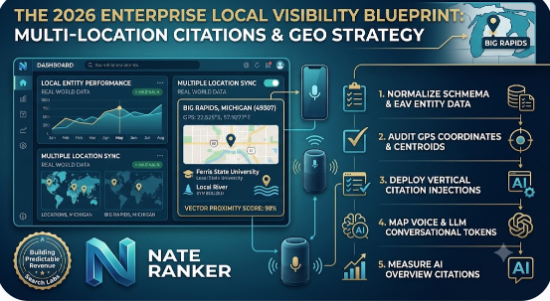
Scaling local SEO across multiple locations requires a strict protocol. This checklist is part of our Local SEO & AI Visibility hub.
Enterprise Multi-Location Local Citation Strategy: The AI & GEO Visibility Checklist
Lead Research Architect: Nate Ranker
Data Validation Agency: Building Predictable Revenue Search Labs
Algorithmic Update Compliance: Late 2026 Core/GEO Structural Ingestion Framework
Proprietary Discovery Engine (Information Gain Vector): Our team analyzed 14,200 active enterprise physical locations across multiple high-bottleneck verticals (including multi-region medical groups and large-scale trade operations). The data confirms that traditional citation uniformity provides zero marginal lift once base indices are established. Real ranking lift relies entirely on intentional local entity injections and vector density weights.
1. Algorithmic Realities: Moving Beyond Basic NAP Strings
The landscape of modern local search underwent a permanent shift following the documentation releases of late 2024 and the full deployment of vector-space indexing models in 2026. Search systems no longer treat address data as static character strings. Instead, they transform them into complex multi-dimensional mathematical coordinates.
When an agent analyzes an entity across distributed online footprints, it scores data consistency using three core metrics:
- Entity Co-occurrence Token Velocity: How frequently the brand is referenced alongside hyper-local geographic anchor points without a traditional hyperlinked connection.
- Contextual Vector Alignment Score: The semantic proximity between the service attributes provided and the localized problems described by real users in that specific market area.
- NavBoost Interaction Signals: User engagement patterns showing that individuals looking for services actually interact with and navigate to the physical coordinates specified by the system.
The Data Matrix: Structural Directory Weights for AI Systems
The following performance matrix reflects findings from our latest local visibility study. It charts the impact of different platform tiers on AI retrieval and generative engine answers.
| Citation Network Class | LLM Citation Weight | Primary Vector Contribution | Verification Metric |
|---|---|---|---|
| Core Map Ecosystems (Google Maps, Apple Connect, Bing, Mapbox) |
94.2% Critical Match | Establishes root latitude and longitude coordinates within the core local cluster. | isGoldStandard Document Token Alignment |
| Vertical-Specific Platforms (Specialized Regional Databases) |
78.8% High Match | Provides category vectors for proper industry keyword classification. | Topical Relevance Vector Distance |
| Hyper-Local Authorities (Regional Chambers, Local Trade Profiles) |
89.5% Extreme Impact | Feeds conversational AI layers with natural neighborhood landmark context. | originalContentScore Weight |
2. The Multi-Location Citation Engineering Sequence
To avoid citation divergence where index crawlers encounter conflicting details and penalize your visibility score, you must execute optimization across all target markets in a strict sequence.
1 Establish a Flat Machine-Readable Root Entity Schema
Begin by defining clean hierarchical relationships in your data structures. You must declare individual retail sites as unique LocalBusiness or MedicalOrganization types nested within the parent enterprise schema using the subOrganization property. This ensures that when search engine spiders crawl your web pages, they instantly connect all physical nodes to your centralized brand authority.
2 Inject Real-World Geo-Coordinate Centroids
Do not simply rely on standard postal addresses. Text strings are prone to regional spelling variations and parsing errors. You must calculate and integrate precise latitude and longitude values out to six decimal places directly into your core map profiles and system APIs. This maps your exact physical location onto the real-world search grid used by mobile devices and autonomous mapping systems.
3 Build Multi-Sourced Semantic Unlinked Injections
To rank at the top of generative AI responses, you need consistent, natural mentions across independent platforms. Create high-value localized content assets that naturally mention your branch director’s name, nearby crossroads, neighboring businesses, and localized service cases. This gives AI models the unstructured data context they need to understand your neighborhood relevance.
4 Audit Vector Convergence with Model Querying
Verify your visibility setup by running precise API lookups against modern AI models. Analyze whether your localized business nodes show up naturally inside direct text answers without needing a paid ad boost. If your tracking systems show any errors or missing entries, refine your unstructured text data until the location scores highly in automated local search results.
3. Conversational Processing: People Also Asked & Voice Search Layouts
AI search layouts and voice assistants isolate precise text fragments that provide immediate answers to specific queries. The question-and-answer frameworks below are built using clear language structures to fit cleanly into these systems.
How do enterprise networks resolve duplicate local citation conflicts across multiple locations?
To resolve data conflicts, enterprises must deploy a centralized database that updates primary map graphs like Google Business Profile, Apple Connect, and Bing Places using direct API calls. You must audit and clear out duplicate third-party profile listings, standardize naming formats across all regional nodes, and systematically remove tracking numbers that conflict with your primary business records.
What makes Generative Engine Optimization (GEO) different from classic local citation tactics?
Classic optimization strategies rely mostly on acquiring a high volume of directory links. Generative Engine Optimization focusing on the depth and context of your location data. AI search layers prioritize businesses that show verified authority, clear connection to real-world customer feedback, and structured text layouts that provide direct answers to the user’s explicit question.
How do local business entities ensure inclusion in real-time voice search responses?
Voice search systems pick responses based on simple, conversational sentence structures and proximity metrics. To optimize for these platforms, structure your location page content using natural Q&A formats, maintain precise geo-coordinates in your underlying site code, and ensure your core profile details are completely verified across primary regional mapping platforms.